Tibet
7 days
·
Groups up to 16
Trip at a Glance
Starts
Lhasa, Tibet (3,650 m / 11,975 ft))
Ends
Gyirong Port - Nepal Border (1,850 meters, 6,070 ft)
Highest altitude
5,248 m (17,217 ft) (Gyatso La Pass)
Trip style
Private & Small Group
Difficulty
Moderate Plus
Accommodation
Mid‑range hotels where good options are available; best available in remote areas.
Meals
Breakfast
Activities
Cultural sightseeing, walking, overland travels
Transport
Private van or coach
Best season
April to May, September to October
Guides
Local certified guide
Trip Introduction
A 7-day overland drive from Lhasa across the Tibetan Plateau to the Nepal border at Gyirong, with three nights in Lhasa for the Potala Palace, Jokhang Temple and the debating monks of Sera. On the road you pass Yamdrok Lake and Karola Glacier, cross Gyatso La, and spend a night beneath the North Face of Everest at Rongbuk before dropping into the green Gyirong Valley.
Trip Highlights
Sacred UNESCO Treasures in Lhasa: Kick off your Lhasa to Kathmandu tour exploring the architectural marvel of the Potala Palace, the ancient Tibet Museum, and the vibrant pilgrim circuit around Jokhang Temple and Barkhor Street.
Monastic Universities & Debates: Visit historic Drepung Monastery and witness the lively, rhythmic philosophical debates between monks in the shady courtyards of Sera Monastery.
Holy Yamdrok Lake & Karola Glacier: Drive past the shimmering turquoise waters of sacred Yamdrok Lake and stand before the cascading ice walls of Karola Glacier (5,012 m) along the Friendship Highway.
Seat of the Panchen Lamas in Shigatse: Explore Tashilhunpo Monastery in Tibet’s second-largest city, home to a monumental 26-meter gilded bronze statue of Maitreya Buddha.
Iconic 8,000-Meter Mountain Passes: Cross soaring passes on this Tibet to Nepal overland tour, including Gyatso La (5,280 m) and Gawula Pass (5,198 m), for a breathtaking panoramic view of Everest, Lhotse, Makalu, and Cho Oyu.
North Everest Base Camp & Sunset: Take the eco-shuttle along the Tibet to Nepal via EBC route to visit Rongbuk Monastery, the world’s highest monastery, and spend an unforgettable night facing the towering North Face of Mount Everest as dusk turns the summit golden.
Dramatic Himalayan Descent to Gyirong: Experience a spectacular landscape shift on this Lhasa to Kathmandu via Everest Base Camp road trip, descending over 2,300 meters from the high, arid plateau down into the lush, forested gorges of Gyirong Valley.
Cross-Border Himalayan Connection: Walk across the historic Friendship Bridge at Gyirong Port from Tibet into Nepal to complete your ultimate trans-Himalayan Lhasa to Kathmandu overland tour.
Day-by-Day Itinerary
Day 1: Welcome to Lhasa – Arrival & Acclimatization
Tashi Delek! Welcome to Lhasa, Tibet!
Your Lhasa to Kathmandu Overland Tour begins today as you arrive on the legendary Tibetan Plateau and take your first steps into the cultural heart of Tibet. This first day is intentionally easy-paced, allowing your body time to adjust to Lhasa’s high altitude before the journey continues toward Shigatse, Everest Base Camp, and eventually Nepal.
Morning/Afternoon: Arrival in Lhasa
Upon arrival at Lhasa Gonggar Airport or Lhasa Railway Station, meet your local Tibetan guide and driver, who will welcome you to Tibet and assist with your transfer to the hotel.
If arriving by air, enjoy the scenic drive from Gonggar Airport toward Lhasa, following the broad Yarlung Tsangpo River Valley before continuing into the Lhasa Valley. Along the way, your first views of the Tibetan Plateau reveal rugged mountains, river landscapes, traditional settlements, and prayer flags fluttering in the high-altitude breeze.
Travelers arriving by train will be met at Lhasa Railway Station for the shorter transfer directly to the hotel.
Afternoon/Evening: Hotel Check-In & Acclimatization
After checking into your hotel, spend the remainder of the day resting and becoming accustomed to the elevation. Lhasa lies at approximately 3,650 m (11,975 ft) above sea level, and taking your first day slowly is one of the most important steps toward comfortable acclimatization.
Avoid strenuous sightseeing today. Instead, relax at the hotel, drink plenty of fluids, eat a light meal when you feel hungry, and allow your body to adjust naturally to the thinner air.
This acclimatization period is especially important because the days ahead take you progressively higher across the Tibetan Plateau, eventually reaching Everest Base Camp before the overland journey continues toward the Nepal border.
Day 1 Summary
Maximum Altitude: 3,650 m / 11,975 ft
Overnight Altitude: 3,650 m / 11,975 ft – Lhasa
Driving Distance: Approx. 60–70 km / 37–43 miles from Lhasa Gonggar Airport; considerably shorter from Lhasa Railway Station
Driving Duration: Approx. 1–1.5 hours from the airport; shorter from the railway station
Key Activities: Arrival in Tibet, airport or railway station pickup, scenic transfer, hotel check-in, acclimatization and rest
Meals Included: None
Overnight: Tibet Gorkha Hotel or similar (3-star)
Insider Tip: Take your first day in Lhasa slowly. Stay well hydrated, eat light and easily digestible foods, and avoid alcohol and strenuous physical activity. Mild breathlessness or fatigue can occur while your body adjusts to the elevation. Getting adequate rest tonight will help prepare you for sightseeing in Lhasa and the higher elevations ahead.
Day 2: Lhasa Sightseeing – Drepung & Sera Monasteries
Today is one of the cultural highlights of your Lhasa to Kathmandu Tour, bringing together Lhasa’s most iconic landmarks and sacred spaces. Explore the magnificent Potala Palace, discover Tibetan history and artistic heritage at the Tibet Museum, and then enter the spiritual heart of Old Lhasa at Jokhang Temple and the bustling Barkhor pilgrimage circuit.
Morning: Potala Palace – Icon of Tibet
Begin the day at the magnificent Potala Palace, dramatically rising above Lhasa from the summit of Marpo Ri (Red Hill). Once the winter residence of successive Dalai Lamas and an important center of Tibetan religious and political life, the palace is today one of Tibet’s most recognizable landmarks and forms part of Lhasa’s UNESCO World Heritage Site.
Your visit takes you upward through a remarkable complex of stairways, courtyards, ceremonial rooms, chapels, and historic chambers.
White Palace: Explore sections of the former administrative and residential complex, including rooms associated with the Dalai Lamas and Tibet’s historical government.
Red Palace: Continue into the spiritual heart of the Potala, where richly decorated chapels contain Buddhist statues, murals, sacred scriptures, reliquaries, and magnificent gilded stupas associated with former Dalai Lamas.
As you move through the palace, your guide will explain the religious symbolism, architecture, history, and traditions connected with this extraordinary monument.
Potala Palace Visit: Visiting the Potala requires climbing numerous stairs at high altitude, so walk slowly and take your time. Entry is controlled by assigned time slots, and your guide may adjust today’s sightseeing sequence according to the confirmed reservation. Security restrictions apply, and photography is prohibited in many interior areas. Carry your original passport for identity verification.
Midday: Tibet Museum – History, Art & Culture of the Plateau
Continue to the Tibet Museum, where extensive collections provide broader context for the history, artistic traditions, archaeology, religion, and everyday cultures of the Tibetan Plateau.
Explore galleries displaying archaeological discoveries, historical documents, religious objects, traditional costumes, sculptures, paintings, handicrafts, and other artifacts representing different periods and regions.
The museum’s collection of Tibetan Buddhist art is particularly noteworthy, with examples of thangka paintings, Buddhist statuary, ritual objects, manuscripts, and decorative arts that help illuminate many of the religious traditions encountered during your journey.
The museum also provides a useful contrast to the morning’s more physically demanding visit to the Potala, allowing time to explore at a relaxed pace before continuing into Old Lhasa.
Afternoon: Jokhang Temple – Spiritual Heart of Lhasa
Enter the historic center of Old Lhasa to visit Jokhang Temple, one of the most sacred pilgrimage destinations in Tibetan Buddhism.
Founded during the reign of King Songtsen Gampo in the 7th century, Jokhang has drawn pilgrims from across the Tibetan world for centuries. Its dimly lit chapels, ancient statues, butter lamps, murals, and constant flow of worshippers create one of the most memorable spiritual experiences in Lhasa.
At the heart of the temple is the revered Jowo Shakyamuni, traditionally believed to represent the Buddha at the age of twelve and regarded as one of the most sacred Buddhist images in Tibet.
Where access is permitted, continue to the upper levels or rooftop areas for views across the historic quarter and surrounding cityscape.
Temple Etiquette: Follow your guide’s instructions inside Jokhang Temple and respect all restrictions on photography. Avoid interrupting worshippers, touching religious objects, or blocking pilgrimage routes.
Late Afternoon: Barkhor Street & Sacred Kora
Step outside Jokhang Temple onto Barkhor Street, the ancient pilgrimage circuit encircling the temple and one of the liveliest places in Old Lhasa.
Join the flow of Tibetan pilgrims walking clockwise around Jokhang as they spin prayer wheels, recite mantras, carry prayer beads, and make devotional circuits of the sacred temple. Some pilgrims perform full-body prostrations along portions of the route, reflecting traditions that have endured for generations.
Beyond its religious importance, Barkhor remains a fascinating center of local life. Traditional storefronts and market stalls display Tibetan handicrafts, prayer flags, incense, jewelry, textiles, religious objects, and souvenirs.
Take time to absorb the atmosphere of Old Lhasa before returning to your hotel for a final evening in the Tibetan capital.
Tomorrow, your journey leaves Lhasa and begins the true overland portion of the Lhasa to Kathmandu Overland Tour, traveling across the Tibetan Plateau toward Gyantse and Shigatse.
Day 3 Summary
Maximum Altitude: Approx. 3,700 m / 12,139 ft at the upper levels of Potala Palace
Overnight Altitude: 3,650 m / 11,975 ft – Lhasa
Driving Distance: Approx. 15–20 km / 9–12 miles, depending on hotel location and sightseeing sequence
Driving Duration: Approx. 30–60 minutes total
Key Activities: Potala Palace, Tibet Museum, Jokhang Temple, Barkhor Street and sacred kora
Meals Included: Breakfast
Overnight: Tibet Gorkha Hotel or similar mid-range hotel
Timed Entry & Identification: Entry to major attractions such as Potala Palace and Jokhang Temple may be subject to advance reservations, security procedures, real-name registration, and assigned visiting times. Keep your original passport readily available and follow your guide’s instructions regarding the day’s sightseeing sequence. Exact visiting times may be adjusted according to confirmed reservations and local regulations.
Day 3: Iconic Lhasa – Potala Palace, Tibet Museum & Jokhang Temple
Today features the absolute highlight of your stay in Lhasa as part of this Lhasa to Kathmandu tour. You will explore Tibet’s most iconic political, cultural, and spiritual landmarks, seamlessly blending centuries-old grandeur with the rich artifacts and living traditions of local pilgrims.
Morning: The Magnificent Potala Palace
Begin your morning standing before the breathtaking Potala Palace, the former winter residence of the Dalai Lamas and the defining architectural symbol of Tibet. Perched atop Red Hill, this UNESCO World Heritage Site dominates the Lhasa skyline.
White Palace: Walk through the former seat of the Tibetan government, exploring administrative quarters, reception halls, and private living quarters of past Dalai Lamas.Red Palace: Ascend into the sacred heart of the complex to view ancient chapels, rare scriptures, and the awe-inspiring golden tomb stupas of former Dalai Lamas.
Pro-Tip (Potala Palace): Reaching the top of Potala Palace requires climbing over 300 stone steps. Take small, steady steps without stopping abruptly, and pace your breathing to handle the elevation comfortably. Security at Potala Palace is similar to airport screening, do not carry liquids, lighters, or pocket knives. Photography inside the interior chapels is strictly prohibited. Access is regulated by strict timed entry permits, so your guide may adjust today's schedule to match assigned time slots.
Midday: The Tibet Museum
Head to the Tibet Museum, the largest and most modern museum in the region. Spanning thousands of years of Tibetan heritage, this impressive facility offers deep insight into the history, culture, art, and daily lives of the plateau's inhabitants.
Prehistoric & Dynastic Artifacts: View ancient pottery, jade pieces, Imperial seals, and historic documents depicting Tibet’s historical milestones.Sacred Art Collection: Admire rare Thangka paintings, bronze Buddhist statues, ceremonial masks, and intricate gold work spanning various Tibetan art periods.Cultural Exhibits: Discover traditional costumes, folk tools, musical instruments, and exhibits detailing unique regional customs across the Tibetan plateau.
Pro-Tip (Tibet Museum): The museum provides an excellent flat, climate-controlled indoor walk, making it ideal for a relaxing midday break. Make sure to present your ID/passport at entry if required by security, and ask your guide to highlight the key exhibits so you don't miss the most famous imperial gifts and ancient Thangkas.
Afternoon: Jokhang Temple & Barkhor Street Circuit
Head to the historic core of Old Lhasa to visit Jokhang Temple, universally regarded as the ultimate spiritual heart of Tibetan Buddhism.
Jowo Rinpoche: Pay homage before the sacred Jowo Shakyamuni, a life-sized statue of the 12-year-old Buddha brought to Tibet in the 7th century, considered the most revered object in Tibetan Buddhism.Golden Rooftop: Ascend to the upper terrace for sweeping views across Barkhor Square with the distant, towering silhouette of the Potala Palace on the horizon.Barkhor Street Kora: Step out onto the famous Barkhor circuit surrounding the temple. Join thousands of pilgrims spinning prayer wheels clockwise along this sacred path, lined with vibrant market stalls selling Tibetan handicrafts, incense, prayer flags, and local delicacies.
Pro-Tip (Jokhang Temple & Barkhor Street): Photography is strictly forbidden inside the main temple chapels. When walking along Barkhor Street or circumambulating any shrine or temple, always follow local custom by moving in a clockwise direction.
Day Summary
Altitude: 3,650 m / 11,975 ft (Lhasa City)Travel Distance: Approx. 15 km / 9 miles (city transfer between landmarks)Travel Duration: ~30 minutes total drive time throughout the dayKey Activities: Guided tours of Potala Palace, Tibet Museum, Jokhang Temple, and Barkhor Street kora walkOvernight: Tibet Gorkha Hotel or similar (3-Star)Meals: Breakfast included at hotel (Lunch & Dinner on your own)
Potala Palace & Jokhang Temple Timed Entry Rules: Admission to both Potala Palace and Jokhang Temple is strictly regulated by time-controlled entry tickets. Travelers are assigned specific entry times by the palace and temple administration, which cannot be chosen or modified once reserved. You must enter strictly within your designated time slot. Late arrivals may result in denied entry without a refund. Original passports/IDs must be presented at the security checkpoints for real-name verification upon entry.
Day 4: Scenic Drive to Shigatse via Yamdrok Lake & Karola Glacier
Today marks the beginning of the true overland adventure on your Lhasa to Kathmandu Overland Tour. Leaving Lhasa behind, travel deeper into the Tibetan Plateau toward Shigatse on one of the most spectacular driving days of the journey. Cross high mountain passes, gaze across the turquoise waters of sacred Yamdrok Lake, approach the ice-covered slopes of Karola Glacier, and pass through historic Gyantse before reaching Tibet’s second-largest city.
Morning: Gampala Pass & Yamdrok Lake
After breakfast, depart Lhasa and follow the highway southwest before climbing a series of winding mountain roads toward Gampala Pass (4,790 m / 15,715 ft).
From the pass, look down upon the extraordinary turquoise waters of Yamdrok Lake (Yamdrok Tso), one of Tibet’s most revered sacred lakes. Its long, twisting shoreline stretches between barren mountain ridges, creating one of the classic landscapes of the Tibetan Plateau.
On clear days, distant snow-covered Himalayan peaks rise beyond the lake, including Nyenchen Khangsar, the dominant mountain of the surrounding region.
Descend from the pass and follow the lakeshore, stopping at scenic viewpoints where the color of the water shifts with the changing sunlight and surrounding mountains.
High-Altitude Pacing: Gampala Pass is your first extended stop near 4,800 m (15,750 ft). Move slowly, avoid unnecessary exertion, and let your guide know immediately if you experience significant headache, dizziness, nausea, or unusual shortness of breath. At some viewpoints, local residents may offer photographs with decorated yaks or Tibetan Mastiffs. Confirm the price before taking photographs.
Late Morning/Midday: Tibetan Village & Family Lunch
Continue along the shores of Yamdrok Lake and into the rural countryside, where small villages and farming communities provide a glimpse into everyday life beyond Tibet’s larger cities.
Stop at a local Tibetan home for a simple family-hosted lunch, offering an opportunity to experience local hospitality and see a quieter side of life on the plateau.
Depending on the household and season, lunch typically consists of simple Tibetan or home-style dishes prepared with locally available ingredients.
Early Afternoon: Karola Glacier
After lunch, continue toward Karola Glacier, one of the most striking natural landmarks along today’s route.
The road climbs once again into a stark high-altitude landscape beneath the snow-covered massif of Nyenchen Khangsar. Near the glacier viewpoint, enormous walls of snow and ice descend from the mountain toward the highway, providing a dramatic introduction to the increasingly rugged terrain ahead.
At approximately 5,000 m (16,400 ft), this is the highest point of today's journey and significantly higher than Lhasa. Keep walking to a minimum, move slowly, and enjoy the scenery without unnecessary exertion.
Facilities Along the Route: Restroom facilities at remote viewpoints and roadside stops can be basic. Keep toilet tissue, hand sanitizer, drinking water, and other personal essentials readily accessible in your daypack.
Afternoon: Gyantse & the Nyang River Valley
Descend from the high mountains toward Gyantse (approx. 3,950 m / 12,960 ft), historically one of Tibet’s most important trading and agricultural towns.
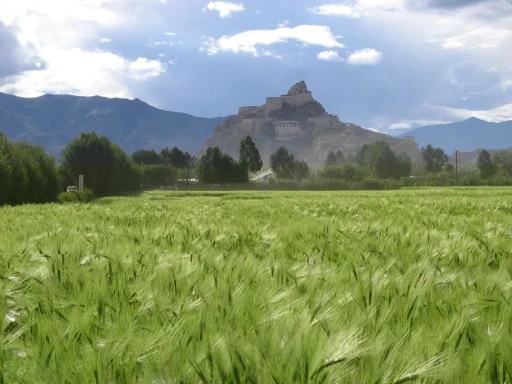
As you approach, look for Gyantse Dzong, the imposing fortress rising from a rocky hill above the town. Depending on timing and road conditions, pause for photographs and views of this historic landmark before continuing toward Shigatse.
The landscape gradually changes as the road enters the fertile Nyang River Valley, an important agricultural region where fields spread across the broad valley floor beneath dry mountain slopes. Depending on the season, you may see expanses of highland barley and other crops in shades ranging from spring green to golden autumn.
This scenic agricultural corridor offers a striking contrast to the barren high passes crossed earlier in the day.
Late Afternoon/Evening: Arrival in Shigatse
Continue through the Nyang River Valley to Shigatse (3,845 m / 12,615 ft), Tibet’s second-largest city and historically associated with the Panchen Lamas.
Check into your hotel and spend the evening resting after a long but exceptionally scenic day across the plateau.
Tomorrow, the journey pushes farther west into increasingly remote landscapes as you travel toward Everest Base Camp, with your first great views of the world’s highest Himalayan peaks along the way.
Day 4 Summary
Maximum Altitude: Approx. 5,000 m / 16,400 ft – Karola Glacier area
Overnight Altitude: 3,845 m / 12,615 ft – Shigatse
Driving Distance: Approx. 350 km / 217 miles
Driving Duration: Approx. 7–8 hours, excluding extended sightseeing and meal stops
Key Activities: Gampala Pass, Yamdrok Lake, Tibetan family-hosted lunch, Karola Glacier, Gyantse and the Nyang River Valley
Meals Included: Breakfast and local family-hosted lunch
Overnight: Gesar Hotel or similar – Shigatse
Day 5: Shigatse to Everest Base Camp (Tibet Side)
Today is one of the defining highlights of your journey as you leave Shigatse and travel deep into the high Tibetan Plateau toward the North Face of Mount Everest. Follow the legendary Friendship Highway through vast valleys and high mountain passes, enter the Mount Everest region, and experience an extraordinary Himalayan panorama before reaching Rongbuk and Everest Base Camp.
Morning: Friendship Highway & Gyatso La Pass
Depart Shigatse early and travel west along the Friendship Highway (G318) through an immense landscape of open valleys, farming settlements, barren hills, and distant snow-covered mountains.
Continue toward Lhatse, where you will stop for an early lunch before climbing into increasingly high and remote terrain.
The road eventually reaches Gyatso La Pass (5,280 m / 17,323 ft), one of the highest points on your journey. Prayer flags flutter across the windswept pass, marking your transition into the rugged landscapes leading toward the Everest region.
On a clear day, the surrounding mountains and immense Tibetan Plateau provide a dramatic preview of the Himalayan scenery ahead.
High-Altitude Pacing: At more than 5,000 m (16,400 ft), oxygen levels are substantially lower than in Lhasa. Keep your stop relatively brief, walk slowly, stay protected from the wind and cold, and tell your guide immediately if you develop significant headache, nausea, dizziness, unusual fatigue, or difficulty breathing.
Midday/Afternoon: Gawula Pass & Himalayan Panorama
Continue past the Shegar area and turn toward the Mount Everest region, climbing a spectacular series of switchbacks toward Gawula Pass (approx. 5,198 m / 17,054 ft).
Weather permitting, Gawula offers one of the great Himalayan panoramas of the entire journey. From this extraordinary viewpoint, look across a vast sweep of snow-covered peaks that can include Mount Everest (8,848.86 m / 29,031.7 ft), Lhotse (8,516 m / 27,940 ft), Makalu (8,485 m / 27,838 ft), and Cho Oyu (8,188 m / 26,864 ft), four of the world’s fourteen 8,000-meter mountains.
Mount Everest now becomes the dominant feature of the journey, rising above the surrounding Himalayan range as you begin descending from the pass.
Mountain Views: Himalayan visibility depends entirely on weather and cloud conditions. Keep a warm windproof layer and camera readily accessible so you can make the most of clear viewing opportunities whenever they appear.
Afternoon: Transfer Toward Rongbuk & Everest Base Camp
Continue through the high-altitude valleys and settlements leading toward Rongbuk. Depending on current reserve regulations and local transport arrangements, private vehicles may be required to stop at a designated transfer point, where you continue aboard an authorized Everest scenic-area shuttle toward Rongbuk and Everest Base Camp.
Pack the warm clothing, medications, camera equipment, toiletries, and other essentials you may need for the night in an easily accessible daypack, particularly if your main luggage must remain with the private vehicle during the shuttle transfer.
As you travel deeper into the valley, the North Face of Mount Everest grows increasingly imposing, creating one of the most memorable approaches to the world's highest mountain.
Late Afternoon: Rongbuk Monastery & Mount Everest
Arrive in the Rongbuk area at approximately 5,000 m / 16,400 ft, beneath the immense North Face of Mount Everest.
Visit Rongbuk Monastery, one of the world's highest-elevation monasteries and an extraordinary spiritual outpost in the shadow of Everest. Its modest monastic buildings, prayer flags, chortens, and stark Himalayan surroundings create a dramatic contrast with the enormous mountain rising beyond.
When weather conditions cooperate, the Rongbuk area provides magnificent views of Everest, particularly as the changing afternoon light moves across its upper slopes.
Evening: Everest Base Camp & Sunset Views
Continue toward the designated Everest Base Camp visitor area, subject to current access regulations and operating conditions.
Standing beneath the North Face of Mount Everest is the culmination of today's remarkable journey. From the visitor area, take in the scale of the mountain and the surrounding Rongbuk Valley while your guide explains the geography and mountaineering history of Everest's Tibetan side.
If skies remain clear toward evening, watch the changing light illuminate Everest's upper slopes, an unforgettable conclusion to one of the most spectacular days of your Tibet to Nepal Overland Tour.
Walking options, shuttle arrangements, and access points in the Everest Base Camp area can change according to reserve regulations, weather, road conditions, and seasonal operating procedures. Your guide will determine the most appropriate arrangements locally.
Everest Base Camp at 5,000 m: Avoid strenuous activity even if you feel well. Walk slowly, stay warm and hydrated, and communicate any altitude-related symptoms to your guide. Conditions can become cold and windy very quickly after sunset.
Accommodation at Everest Base Camp & Rongbuk
Accommodation in the Everest region is considerably more basic than in Lhasa or Shigatse and should be approached as part of the high-altitude adventure.
Depending on the season, availability, and current local operating arrangements, accommodation may be provided at Rongbuk, an Everest-area guesthouse, or an authorized tented accommodation facility. Rooms and facilities are simple, and bathroom facilities may be shared. Running water and other services can be limited at this altitude.
Warm clothing is essential. Even during the main travel season, temperatures can fall sharply after sunset, while nights during colder periods can drop well below freezing.
Because accommodation arrangements and seasonal camp operations in the Everest region can change, the exact property will be reconfirmed according to availability and current local regulations.
For travelers who prefer not to sleep at approximately 5,000 m (16,400 ft), a lower-altitude overnight option may sometimes be arranged in a nearby settlement, subject to the itinerary, transportation arrangements, and local operating conditions. This should be requested in advance rather than decided after arriving at Everest Base Camp.
Day 5 Summary
Maximum Altitude: 5,280 m / 17,323 ft – Gyatso La Pass
Overnight Altitude: Approx. 5,000 m / 16,400 ft – Rongbuk/Everest Base Camp area
Driving Distance: Approx. 340–390 km / 211–242 miles, depending on the current access and shuttle route
Driving Duration: Approx. 7–9 hours, including mountain roads and local transfers but excluding extended sightseeing stops
Key Activities: Friendship Highway, Gyatso La Pass, Gawula Pass, Himalayan panorama, Mount Everest views, Rongbuk Monastery and Everest Base Camp
Meals Included: Breakfast
Overnight: Rongbuk/Everest Base Camp area – basic guesthouse or seasonal authorized accommodation, subject to availability and local operating conditions
Day 6: Everest Base Camp to Gyirong Town (Descending into the Valley)
Today brings one of the most dramatic landscape transitions of your Lhasa to Kathmandu Overland Tour. Begin with the possibility of sunrise over Mount Everest before leaving the high, arid plateau and traveling west toward Gyirong. Along the way, cross remote Himalayan terrain, pass the turquoise waters of Peiku Tso, look toward mighty Shishapangma, and eventually descend into the greener valleys of southwestern Tibet.
Early Morning: Sunrise over Mount Everest
Weather permitting, rise early for a final view of the North Face of Mount Everest. On a clear morning, the first sunlight can illuminate the upper slopes of the mountain in shades of gold and rose while the surrounding Rongbuk Valley remains in shadow.
After breakfast, bid farewell to Everest and begin the journey away from the Rongbuk region. Depending on current reserve transportation regulations, return by authorized shuttle to the designated transfer point and reunite with your private driver and vehicle.
From here, continue west across the Tibetan Plateau toward Gyirong, beginning the next stage of your Tibet to Nepal Overland Tour.
Everest Sunrise: Mountain weather is unpredictable, and sunrise views cannot be guaranteed. Even when Everest is hidden by clouds at first light, conditions can change quickly, so keep warm clothing and your camera readily accessible.
Morning: Across the Tibetan Plateau toward Peiku Tso
Travel through an immense high-altitude landscape of broad valleys, barren mountains, grazing lands, and scattered Tibetan settlements as the route continues across southwestern Tibet.
One of the day's major natural highlights is Peiku Tso, a beautiful high-altitude lake set against the stark mountains of the Tibetan Plateau. Its blue-green waters and isolated setting provide a striking contrast to the dry surrounding landscape.
On clear days, the journey also offers views toward Shishapangma (8,027 m / 26,335 ft), the world's 14th-highest mountain and the only 8,000-meter peak located entirely within Tibet.
Depending on weather, road conditions, and available stopping points, pause for photographs of the lake and surrounding Himalayan scenery.
Midday: High Passes & Remote Himalayan Landscapes
Continue across the high plateau, crossing mountain passes and traveling through some of the most sparsely populated terrain of the journey.
From the higher sections of the route, clear weather may reveal sweeping views across the Himalayan range before the road begins its long descent toward the Gyirong region.
The landscape gradually changes as elevation decreases. The vast, dry expanses of the plateau give way to deeper valleys, increasingly vegetated mountain slopes, rushing streams, and a noticeably milder environment.
This remarkable ecological transition is one of the defining features of the historic overland route between Tibet and Nepal.
Afternoon: Descend into the Gyirong Valley
Continue into the Gyirong Valley, where the scenery becomes dramatically greener than the high Tibetan Plateau you have traveled through during the previous several days.
Forested slopes, steep mountain walls, waterfalls, streams, and cultivated areas begin to replace the stark high-altitude scenery. After several nights at elevations approaching 4,000–5,000 m, the descent also brings noticeably denser air and generally milder temperatures.
Arrive in the Gyirong area by late afternoon and check into your hotel.
Spend the remainder of the day relaxing after the long drive and enjoying the striking change in environment.
Evening: Overnight in Gyirong
Settle in for the night in Gyirong and enjoy a well-earned rest after your journey from Everest.
Gyirong historically serves as the gateway between Tibet and Nepal on this classic overland route. International border-crossing arrangements are subject to current government regulations, road conditions, immigration procedures, and the operating status of the Tibet–Nepal land border.
Your guide will brief you on the latest confirmed arrangements for the following day. If the international land crossing is not operating, alternative onward travel arrangements will apply according to the itinerary confirmed before departure.
Day 6 Summary
Maximum Altitude: Approx. 5,000 m+ / 16,400 ft+ – Everest region and high plateau route
Overnight Altitude: Approx. 2,700 m / 8,858 ft – Gyirong area
Driving Distance: Approx. 330 km / 205 miles, depending on current routing and transfer arrangements
Driving Duration: Approx. 6–8 hours, excluding sightseeing and rest stops
Key Activities: Mount Everest sunrise viewing (weather permitting), departure from the Everest region, Peiku Tso, views toward Shishapangma, high Tibetan Plateau landscapes, mountain passes and descent into the Gyirong Valley
Meals Included: Breakfast
Overnight: Gyirong Shengtai Hotel or similar
Day 7: Gyirong Port Border Crossing & Transfer to Kathmandu Independently
Today marks the conclusion of your Lhasa to Kathmandu Overland Tour as you descend from Gyirong toward the Tibet–Nepal frontier. When the international land border is operational, complete Chinese exit formalities, cross into Nepal at Rasuwagadhi, and continue independently or by a pre-arranged private transfer through the Himalayan foothills to Kathmandu.
Morning: Gyirong to the Tibet–Nepal Border
After breakfast, meet your Tibetan guide and driver and begin the final drive through the spectacular Gyirong Valley toward the international border.
The road descends through a dramatic Himalayan gorge, following rushing mountain rivers beneath steep forested slopes as you approach the Chinese immigration and customs facilities.
Upon arrival, your guide will assist with the required Chinese exit formalities, including immigration and customs procedures. Keep your original passport and other required travel documents readily accessible.
After completing the formalities, bid farewell to your Tibetan guide and driver, whose services conclude on the Chinese side of the border.
Border Procedures: International border operating hours, immigration procedures, crossing arrangements, and security requirements can change without notice. Your Tibetan guide will confirm the current procedures locally and assist you through the Chinese side of the border.
Midday: Cross into Nepal at Rasuwagadhi
When the Gyirong–Rasuwagadhi international border is open to foreign travelers, cross from Tibet into Nepal and proceed through the required Nepalese immigration and customs formalities.
Please note that meet-and-greet assistance on the Nepal side and transportation from Rasuwagadhi to Kathmandu are not included in the tour cost.
You have two options for your onward journey:
Pre-arranged private transfer: Far & High Adventure Travel can arrange for a Nepalese representative and private vehicle to meet you on the Nepal side and transfer you to Kathmandu. This service must be requested in advance and is available at an additional cost.
Independent transportation: You may arrange your own local taxi or shared/private vehicle after completing the border formalities. Availability, vehicle standards, departure times, and fares can vary, so this option is best suited to travelers comfortable making their own local transportation arrangements.
Travelers who require a Nepal tourist visa may generally obtain a Visa on Arrival at eligible Nepal immigration entry points, subject to nationality and current immigration regulations. Confirm your visa eligibility and current entry requirements before departure.
Important: Your included Tibetan guide and vehicle services end on the Chinese side of the border. Unless you have booked our optional Nepal-side meet-and-greet and private transfer in advance, you will be responsible for arranging your own transportation from Rasuwagadhi to Kathmandu.
Afternoon: Rasuwagadhi to Kathmandu
After completing Nepalese immigration and customs formalities, begin your onward journey to Kathmandu (approx. 1,400 m / 4,593 ft) by your pre-arranged private vehicle or independently arranged local transportation.
The route follows winding mountain roads through the Himalayan foothills, passing steep river valleys, terraced hillsides, waterfalls, rural settlements, and cultivated farmland.
Road conditions in this mountainous region can vary considerably due to weather, landslides, construction, and seasonal conditions. Travel times should therefore always be considered approximate.
As you descend toward the Kathmandu Valley, the landscape becomes increasingly lush and populated, a remarkable contrast to the vast, high-altitude terrain of Tibet crossed during the previous week.
Arrive in Kathmandu in the late afternoon or evening, depending on border formalities, road conditions, and your chosen transportation arrangement.
Your extraordinary Tibet to Nepal Overland Tour concludes in Kathmandu after an unforgettable journey from the sacred monasteries and palaces of Lhasa across the Tibetan Plateau, past Yamdrok Lake and the great Himalayan peaks, beneath the North Face of Mount Everest, and finally into the green valleys of Nepal.
Day 7 Summary
Starting Altitude: Approx. 2,700 m / 8,858 ft – Gyirong
Ending Altitude: Approx. 1,400 m / 4,593 ft – Kathmandu
Travel Distance: Varies according to current border access and road routing
Travel Duration: Full-day journey; timing depends on immigration procedures, road conditions, and transportation arrangements
Key Activities: Gyirong Valley descent, Chinese exit formalities, Tibet–Nepal border crossing when operational, Nepal immigration formalities, and onward journey to Kathmandu
Meals Included: Breakfast
Nepal-Side Meet & Greet: Not included; available by advance arrangement at additional cost
Rasuwagadhi–Kathmandu Transportation: Not included; optional private transfer can be pre-arranged at additional cost, or travelers may arrange local transportation independently
Overnight: Kathmandu hotel – not included
Important Border Status Notice: The Gyirong–Rasuwagadhi land crossing is subject to closure following floods, landslides, road damage, or government restrictions. At the time of booking and again before departure, Far & High Adventure Travel will confirm whether the international border is open to foreign travelers and whether this overland itinerary can operate as described. If the crossing is closed, the Tibet-to-Nepal overland segment cannot operate as published, and alternative travel arrangements or itinerary modifications will be required.
Nepal Extension Options
If you would like to continue exploring Nepal after arriving in Kathmandu, consider adding one of our Nepal extensions:
4-Day Kathmandu Valley Explorer
8-Day Classic Nepal Adventure
Tour Route
Dates and prices
Pick a start date and your group size to see the price per person. Every departure is private unless it is listed as a group trip.
What’s included
Included
Tibet entry permit.
Accommodation on double occupancy basis.
Daily Breakfast at your hotel.
All transfers and sightseeing by a private vehicle
Sightseeing admission fees.
English speaking local certified Guide.
Not included
Airfare into Lhasa
Chinese visa.
Lunch and dinner.
Drinks, tipping, laundry, phone, internet, and other personal expenses.
Travel insurance
All extra costs due to nature or unforeseen events.
Transportation from Nepal border to Kathmandu
FAQs
I am entering Tibet form mainland China. What travel documents do I need ?
Entering Tibet from mainland China.
Passport
You must hold a valid passport with at least six months of remaining validity beyond your return date, as well as a minimum of two blank visa pages. You can apply for an individual Chinese visa through the Chinese Embassy or your nearest Chinese Consulate. Please note that Chinese embassies and consulates do not accept visa applications by mail or online. You must apply in person, entrust someone to submit on your behalf, or hire a visa agency.
Submit your Chinese visa and a scan of your passport at least 45 days before your trip.
Please provide color scans of your passport photo page and Chinese visa no later than 45 days before your arrival in Lhasa. Our ground operator in Lhasa will then apply for your Tibet Entry Permit. An original copy of the permit will be couriered to your hotel in the gateway city three to four days prior to your flight. A digital copy will also be emailed to you; however, you must present the original permit along with your passport when boarding your flight to Lhasa.
Other documents
In addition, several other permits, such as the Alien’s Travel Permit and the Military Permit, will be arranged by our ground partner in advance. Your guide will carry all required documents for you throughout the journey.
I am entering Tibet from Kathmandu, Nepal.What travel documents do I need ?
Visa & Documentation: Entering Tibet from Nepal
Traveling into Tibet from Kathmandu requires specific permits and visas. Please review the passport and visa requirements carefully to ensure smooth entry.
Passport Requirements
Validity: Your original passport must be valid for at least 6 months beyond your planned travel dates.
Blank Pages: Must contain at least two full, consecutive blank visa pages for entry and exit stamps.
Chinese Visa Options (Individual vs. Group Visa)
Option A: Individual Chinese Visa (Strongly Recommended): Unlike past regulations, if you hold an individual Chinese Visa stamped directly in your passport prior to travel, you do not need a paper Group Visa to enter Tibet from Kathmandu.
Advantage: Allows you to enter Tibet seamlessly using your existing individual visa paired with the Tibet Travel Permit arranged by our team.
Requirements: Simply send us a high-resolution color scan of your passport photo page and valid Chinese Visa at least 45 days prior to your trip departure date.
Option B: Chinese Group Visa (From Kathmandu): If you do not hold an individual Chinese visa, a paper-based Chinese Group Visa can be arranged through the Chinese Embassy in Kathmandu upon arrival.
Important Note: Processing requires at least 5 working days before your Tibet entry date while your original passport is submitted to the embassy. Due to the processing timelines, obtaining an individual Chinese Visa in advance is always the preferred and most convenient option.
Tibet Permits & Required Submissions: To process your official travel authorization, we require the following documents no later than 45 days before your arrival date:
Color Scans Required: Clear, high-resolution color scans of your passport photo page and Chinese Visa.
Permit Processing: Our ground team in Lhasa uses these documents to secure your official Tibet Travel Permit (TTP).
Additional Required Permits (Handled Automatically)
Depending on your exact itinerary, including overland travel to Mount Everest Base Camp, additional regional authorizations are required:
Alien’s Travel Permit (for travel in restricted regions outside Lhasa, such as Shigatse and EBC)
Military & Border Permits (for border transit zones)
Stress-Free Logistics
You do not need to apply for these additional permits yourself. Our local team arranges all documentation in advance, and your certified Tibetan guide will carry and manage all original permit paperwork throughout your journey.
Can I travel to Tibet independently?
No. All foreign travelers must join an organized tour arranged through a licensed travel agency. A private vehicle, driver, and certified tour guide are required for the entire duration of your stay in Tibet.
What is a Tibet Travel Permit (TTP)? How I obtain it?
The Tibet Travel Permit (TTP), also known as the Tibet Entry Permit or TTB Permit, is the official government document issued by the Tibet Tourism Bureau that allows non-Chinese passport holders to enter and travel within the Tibet Autonomous Region (TAR).
Because independent travel for international tourists is restricted in Tibet, the TTP serves as your primary authorization to enter the region alongside your passport and Chinese Visa.
Passport + Chinese Visa + Tibet Travel Permit (TTP) ──► Board Flight/Train to Tibet
Key Facts About the Permit
What It Looks Like: A physical two-page document. Page 1 details your fixed itinerary and entry dates; Page 2 lists your personal details (full name, passport number, nationality).
Where It Is Checked: You must show the physical permit (or an official color copy, depending on your route) when boarding flights or trains to Lhasa, checking into hotels, and passing through security checkpoints along highways like the G318 to Everest Base Camp.
Fixed Itinerary: The permit strictly binds your travel to the exact route, dates, and cities approved by the bureau.
How and Where Can You Get It?
You cannot apply for or purchase a Tibet Travel Permit on your own. The Tibet Tourism Bureau does not accept individual applications directly from independent travelers, nor can you obtain one at a Chinese embassy, consulate, or border entry post.
Step 1: Book Tour Package with a local travel agency or their overseas partner such as Far & High Adventure travel
Step 2: Submit Passport & Chinese Visa Scans (45+ Days Prior)
Step 3: Agency Submits Application to Tibet Tourism Bureau
Step 4: Permit Issued ──► Delivered to your Hotel in China (or electronic copy emailed to you and the original held at Nepal Border )
The Only Official Channel: Licensed Travel Agencies
The only legal way to get a Tibet Travel Permit is through an authorized, licensed travel agency. The permit is automatically applied for as part of your pre-arranged tour package.
Required Documents to Provide
To submit the application on your behalf, your travel operator needs:
High-Resolution Passport Scan: Color copy of your passport photo page (valid for at least 6 months).
Chinese Visa Scan: Color copy of your valid Chinese Tourist Visa (L-Visa). (Note: If you qualify for China's 15-to-30-day visa-free entry, only your passport scan is required).
Application Timeline
Standard Application Window: Submit your documents at least 30 to 45 days before your planned arrival date in Tibet. Processing typically takes 10 to 15 working days at the bureau.
How the Permit Is Delivered to You
Once approved and printed in Lhasa, how you receive the document depends on your entry gateway:
Mainland China by Flight. The original physical permit is express-mailed directly to your hotel in mainland China (e.g., Chengdu, Beijing, Shanghai) before your flight to Lhasa.
Mainland China by Train: An official color printout copy (or original, depending on the station) is emailed to you to print before boarding the Qinghai-Tibet train.
Kathmandu, Nepal (Flight/Overland):
No Advance Physical Permit Required: You do not need to receive the physical permit in advance before departing Nepal.
Boarding & Check-in: You will be sent an official electronic copy of the permit via email prior to your flight or overland departure. Simply print a copy to present at the airline check-in counter or border post.
On-Arrival Handover: Your certified Tibetan tour guide will hold your original physical permit and meet you directly upon your arrival at Lhasa Airport or the Gyirong Port border crossing.
Do I need other permits for Mount Everest or Mount Kailash?
Yes. Visiting areas outside of Lhasa requires an Aliens' Travel Permit (arranged by your guide after you arrive in Tibet) and potentially a Military Permit for sensitive border zones like Mt. Kailash.
When is the best time to visit Tibet?
• Peak Season (April–October): Mild temperatures and clear skies make this the ideal period for viewing Mt. Everest. • Best Months: May and October often offer the most stable weather and excellent visibility. • Winter (November–January): Very cold but far less crowded, with lower costs and crisp, clear Himalayan views.
How do I get to Tibet?
Getting to Tibet is straightforward once your permits are secured. Because foreign travelers cannot enter Tibet independently, all entry requires a pre-booked tour through a licensed agency to obtain the mandatory Tibet Travel Permit (TTP).
You can enter Tibet via two main gateways: Mainland China or Kathmandu, Nepal, using either flight, high-altitude train, or overland travel.
Entering via Mainland China (Most Popular)
Entering from mainland China gives you the widest range of gateway cities, flight connections, and train routes into Lhasa.
By Air (Fastest): Direct flights to Lhasa Gonggar Airport (LXA) operate daily from major Chinese hub cities, including Chengdu, Chongqing, Xi'an, Beijing, Shanghai, and Kunming. Chengdu and Chongqing offer the most frequent daily departures (approx. 2–2.5 hours flight time).
By Qinghai-Tibet Railway (Most Scenic): The world’s highest railway connects mainland China to Lhasa. While trains depart from cities like Beijing, Shanghai, and Guangzhou, the most famous and scenic segment begins in Xining. The Xining-to-Lhasa train takes about 21 hours, crossing the high Changtang Plateau and Tanggula Pass (5,072m) in pressurized carriages with soft/hard sleeper berths.
Permit Requirement: You must show your original Tibet Travel Permit before boarding any flight or train bound for Lhasa from mainland China. Your permit will be delivered to your hotel in China prior to your departure.
Entering via Kathmandu, Nepal (Trans-Himalayan Gateway)
If your travel itinerary includes Nepal, you can travel directly from Kathmandu to Tibet across the Himalayas.
By Air: Kathmandu based Himalaya Airlines operate direct non-stop flights between Kathmandu (KTM) and Lhasa (LXA) multiple times per week. This short ~1.5-hour flight offers spectacular aerial views of the Himalayan range, including Mount Everest.
By Overland Drive: You can drive overland from Kathmandu to the Tibetan border at Gyirong Port (Zhangmu Port is closed currently), crossing into Tibet to begin your journey toward Shigatse, Everest Base Camp, and Lhasa.
Visa/Permit Requirement: Entering from Nepal requires either an Individual Chinese Visa (if obtained in advance) or a Chinese Group Visa processed via the Chinese Embassy in Kathmandu, paired with your official Tibet Travel Permit.
Note: Our team manages all official permit applications (Tibet Travel Permit, Alien's Travel Permit, and Border Passes) and assists with booking your internal flights or train tickets into Lhasa.
How can I prevent altitude sickness?
If you fly into Lhasa:
Spend 3–4 nights there before traveling to higher regions, such as Everest Base Camp that gives your body time to adjust to the altitude.
Avoid strenuous activities, running, or jumping.
Drink plenty of water (3–4 liters daily) and avoid alcohol and smoking, which can worsen symptoms.
Local experts advise against showering or washing hair for the first 24–48 hours. Showering increases blood circulation and oxygen consumption, while open pores from hot water can make you more vulnerable to catching a cold, which is dangerous at high altitudes.
If you are entering overland, the key guideline is to ascend gradually, ideally gaining no more than 300–500 meters (1,000–1,640 ft) of elevation per day once you are above 3,000 meters.
Is there medication for altitude sickness?
Some travelers use Diamox (acetazolamide), a prescription medication that doctors may recommend to help reduce the effects of altitude. It’s important to consult your healthcare provider before considering it, as they can advise whether it’s appropriate for you.
Many visitors also use local herbal remedies, such as Rhodiola (Hongjingtian). These are traditionally taken well in advance, often 10–14 days before arrival, to allow time for the body to adjust.
Always follow guidance from a medical professional and listen to your body as you ascend to higher altitudes.
What about the fitness level required for a non-trekking trip to Tibet?
For a general, non-trekking trip to Tibet (e.g., Lhasa, Shigatse, and driving to Everest Base Camp), you don't need to be an athlete, but you do need a baseline level of health.
The Reality of “Walking” in Tibet
Even on a non‑trekking tour, you will still do a fair amount of walking on uneven ground and climbing stairs. Many monasteries also have optional circumambulation paths that you may choose to walk.
Basic Fitness Expectations
Cardiovascular Endurance: Your heart and lungs work harder at altitude, even at rest. If you can comfortably walk 3–5 miles on flat ground at home, you’re generally fit enough for a standard Tibet tour.
Leg Strength: Expect many staircases. Travelers with knee or hip issues may find places like the Potala Palace or Barkhor Street more challenging.
Adaptability: The biggest factor isn’t physical strength, it’s how your body responds to lower oxygen levels. Very fit people can still experience altitude discomfort, while less active travelers may adjust easily.
Preparation Suggestions
Light Cardio: About two months before your trip, begin walking or swimming three times a week.
Stair Practice: Choose stairs over elevators to prepare for monastery climbs.
Prioritize Rest: Even good fitness won’t help if you push too hard. The travelers who feel best in Tibet are the ones who move slowly and take frequent breaks.
I have heart and lung issues, as well as high blood pressure. Should I travel to Tibet?
At high altitudes like Lhasa (3,650m) and beyond, the air is much thinner, which puts significant strain on your cardiovascular and respiratory systems as they work harder to deliver oxygen to your body. Conditions like severe coronary artery disease, heart failure (NYHA class >II), or recent heart surgery are typically considered contraindications for high-altitude travel.Chronic Obstructive Pulmonary Disease (COPD), severe asthma, or pulmonary hypertension can make breathing extremely difficult in the low-oxygen environment of the Tibetan plateau. If your BP is uncontrolled, you should not travel. However, if your hypertension is mild and well-managed with medication, you may be at no higher risk than other travelers, provided your doctor clears you.
We can’t assess your medical situation, but a doctor’s guidance is essential before planning a trip like this. A healthcare professional who knows your medical history can help you understand what’s safe for you.
Ask a question
Postak reads and answers every question himself, usually within a day.